




Worries Over MI’s Dams Resurface as Repair Funds Run Dry, Reforms Lag
December 15, 2025
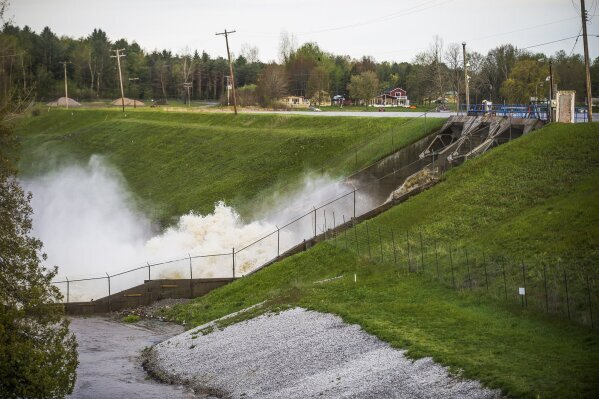
Associated Press / news@whmi.com
Four years ago, in the wake of the infamous Midland dam failures, Michigan lawmakers appropriated more than $50 million to address other problem dams whose owners couldn’t or wouldn’t do so on their own.
The wildly popular funds helped shore up or remove dozens of impoundments, reducing the risk of failure and keeping downstream communities safe from Allegan to Ypsilanti.
“It’s been vital,” said Ypsilanti Economic Development Manager Katie Jones, whose community received $1.6 million to remove a century-old dam that risked killing people and destroying downstream communities if it failed. Without the money, “we’d still be having concerns about how to mitigate that risk.”
Trouble is, Michigan has countless more outdated dams in need of removal or repair, and the public kitty has run dry. Meanwhile, lawmakers still haven’t reformed weak dam safety laws that give private dam owners few incentives to invest in maintenance and upkeep.
After years of striving to whittle down Michigan’s list of unsafe dams, state dam safety chief Luke Trumble is now worried about a backslide as other impoundments show their age.
“We need to invest in those dams, or they’re going to start to crumble similar to a bridge, similar to a pipe in the ground, similar to a road,” said Trumble, who supervises the Michigan Department of Environment, Great Lakes and Energy’s dam safety unit.
The 2020 failures near Midland laid bare the risks posed by Michigan’s roughly 2,600 dams, some two-thirds of which have exceeded their intended lifespan of 50 years.
The structures can last longer with costly maintenance and upgrades, but in Michigan and across the country, many dam owners have deferred those investments, resulting in cracked concrete, leaking embankments, rotting stoplogs and what experts have described as a “looming crisis” of impoundments inching toward failure.
More than 160 state-regulated dams are classified as having high hazard potential, meaning a failure could kill people downstream. About 15% of them are in poor condition or do not have a current rating.
Nearly 100 dams are also in poor condition with lower hazard classifications.
It’s a crisis that mirrors Michigan’s issues with crumbling roads, bridges and water systems, said Dan VanderHeide, president of the American Society of Civil Engineers Michigan section.
“Infastructure’s greatest challenge is that when it is working, it does not complain and it does not receive attention,” VanderHeide said. “Only when it stops working does it receive attention, and that’s exactly the wrong way to go about infrastructure.”
The Sanford and Edenville dams in mid-Michigan became a painful example of the risks when, after years of warnings about their poor condition and outdated design, they failed during a May 2020 rainstorm. The resulting flood forced 10,000 people to evacuate and caused more than $200 million in property damage. Taxpayers have spent hundreds of millions rebuilding the structures.
In the wake of the catastrophe, two independent reviewteams warned that Michigan needed stronger dam safety regulations and more investment to remove or repair aging dams that could cause the next disaster.
Authors urged lawmakers to act swiftly on their recommendations, saying “the potential human and economic costs of business as usual are too great to ignore.”
Lawmakers made no regulatory reforms. But they did free up nearly $50 million for grants to repair, rehab or remove aging dams, plus another $6 million for emergency failure response.
The grant program was wildly popular, with nearly $220 million in grant requests far exceeding the $49 million in available funding. In three years, it paid for projects at 57 dams throughout the state.
But “it was never intended to address all of the needs for all of the dams,” said Trumble.
By one 2021 estimate, that would require $420 million ($521 million in today’s dollars).
With the publicly funded repair kitty now empty and the emergency fund set to sunset at the end of the fiscal year, Michigan is back where it started pre-Midland: Struggling to maintain a fleet of aging dams, with little money to do so and limited incentives for dam owners to do it themselves.
“It’s déjà vu all over again,” said Mark Coscarelli, a longtime environmental policy consultant who led a 2007 project to develop recommendations for Michigan’s aging dams.
Concerns about Michigan’s weak financial oversight and safety laws have become a point of contention as Consumers Energy pushes to sell its 13 hydropower dams to a subsidiary of a Maryland-based private equity firm.
Consumers has spent years looking to exit the dam business because costs to maintain the dams far exceed the value of the power they produce. Utility officials have said selling the dams is the cheapest option for ratepayers.
They contend Hull Street Energy — which formed in 2014 — has a track record of safely maintaining dams.
But that doesn’t reassure state Sen. Jon Bumstead, a North Muskegon Republican who grew up along the Muskegon River, where three of those dams are located.
“Is safety their number one concern?” Bumstead asked, referring to Hull Street. “I don’t know. Usually private equity, their number one concern is making money for their investors.”
Michigan utilities have a long history of selling unwanted dams to more loosely regulated private owners that can’t or won’t pay for maintenance, ultimately forcing taxpayers to pay the tab for repair, removal or recovering from a failure.
Arguing Consumers and Hull Street officials have not explained what makes their plan different, Bumstead teamed up with state Sens. Rosemary Bayer, D-Keego Harbor, and Joseph Bellino, R-Monroe, to craft legislation that would require the Michigan Public Service Commission to probe Hull Street’s finances before approving a sale.
So far, it hasn’t received a hearing.
State regulators and the Association of State Dam Safety Officials are hoping lawmakers will refill the dam safety fund and revive the safety reforms that failed to gain traction after Midland.
Bumstead, who helped create Michigan’s dam safety fund back in 2021, said he doesn’t see it happening this session.
“One chamber doesn’t like the other, so nothing’s getting done right now,” he lamented.
With no money to help fix or remove decrepit dams, state regulators have looked to avoid future disasters by ordering emergency drawdowns at the riskiest impoundments. With less water behind them, the dams can’t flood out downstream communities when they fail.
But the empty reservoirs haven’t been popular with neighbors.
In many communities, dams built to operate mills or provide hydropower have since become community fixtures, their reservoirs functioning as recreational lakes with shores ringed by homes, businesses and parks.
“There’s just a lot of history and tradition and sentimental value,” Coscarelli said.
In Holly, the village government took state dam safety regulators to court over a drawdown order prompted by unstable embankments on Holly Dam, an impoundment built in 1840 to power a former grist mill. The effort failed, and village leaders are now pondering how to come up with the millions of dollars it would take to shore up the dam and refill its 25-acre pond.
The dam is an important piece of Holly’s history and an asset to residents who kayak and fish there, said Village President April Brandon.
But without outside assistance, she said, “I just don’t think (the repair price) is sustainable for a place like Holly.”
In White Cloud, city officials resisted a state-ordered drawdown at the White Cloud Dam after inspectors deemed the structure unsafe, but the state ultimately prevailed. And the Michigan Department of Natural Resources has repeatedly encountered pushback when it has lowered water levels or proposed removing dams to restore rivers or avoid costly repairs.
Trumble said his department doesn’t take pleasure in ordering drawdowns, viewing them as “ a last resort.” But safety is the first priority.
“We can’t just wait and hope that it’ll hold out until the dam owner can address the issue,” he said.
At dams that have not yet deteriorated to the point of near-failure, Trumble advised owners and surrounding communities to make a plan for long-term maintenance.
But given the advanced age of many Michigan dams, Trumble said, “we have to start planning very, very quickly.”