




Former Detroit Mayor Duggan Frames Independent Bid for Governor as a Fix for “Broken” Lansing
March 19, 2026
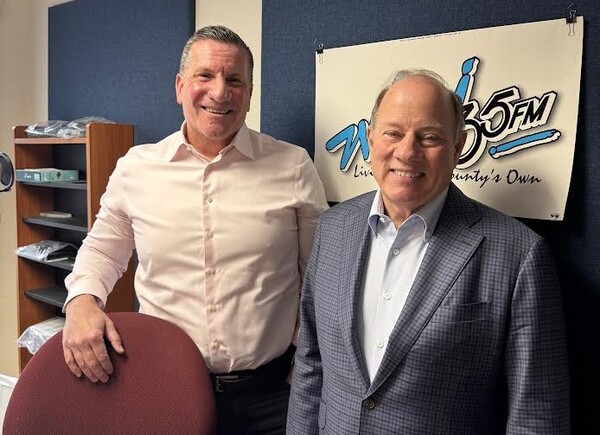
Matt Hutchison / news@whmi.com
Former Detroit Mayor Mike Duggan, in a wide-ranging interview on WHMI’s “Meet the People” podcast, framed his independent run for governor as a direct challenge to what he calls a broken two-party system in Lansing and cited the bipartisan coalition he built in Detroit as a model for state government.
Duggan, a longtime Democrat who left the party in 2024, said the Democratic Party “walked away” from him and has become “a party that is so obsessed with winning that if you look at their messages it is all tearing down the other side.”
“You never see a Democratic Party ad for ‘Here’s what we’re going to do to improve our schools. Here’s what we’re going to do for affordable housing,’” he said. “I’ve dealt with Lansing for 30 years. I’ve never seen it as bad as it’s been in recent years.”
He continued: “There was something about an evenly divided legislature that … when you went up to Lansing and wanted to talk about a bill, it no longer had anything to do with the bill. It was, ‘Does this help me get the majority? Does this help me keep the majority? Can I use this issue to beat up on the other party’?”
He said that if voters send him to Lansing, it would be a “shock to the system” and a strong message to the two parties that “if you keep behaving the way you’re behaving, you don’t own our votes. We can have a third choice.”
The race is widely shaping up as a three-way contest among Duggan, Secretary of State Jocelyn Benson, a Democrat, and Congressman John James, a Republican.
Duggan said he is “building coalitions of Republicans and Democrats, and when we get to Lansing and we deal with schools, we deal with affordable housing, we deal with the jobs of the future so our kids don’t leave, I’m counting on those Republicans and Democratic traditional groups who supported me to then go to the legislature and say we’ve had enough, it’s time to solve these problems.”
He said he’s “pulling equally” from Republicans and Democrats, and his pitch often comes down to this: “If you think the system is broken and you’re fed up, there’s a chance to change it.”
Throughout the interview, Duggan leaned heavily on his record in Detroit, saying he replaced all 65,000 streetlights, slashed the number of abandoned and blighted buildings, brought manufacturing jobs back to the city and helped stabilize neighborhoods. He argued that the real breakthrough was not any single project, but ending what he called Detroit’s long-running “us versus them” politics, enabling business, labor, city government and neighborhoods to work together and accelerate the city’s recovery.
He also repeatedly drew parallels between Detroit in 2013 and Michigan in 2026. He said Detroiters, when he first ran for mayor, felt neglected. Now, he said, people across Michigan feel much the same way about Lansing.
“What I’m finding today is (when) I go to the farms and the small towns around this state, these folks feel like they’ve been forgotten by Lansing,” Duggan said. “It’s amazing the parallels of 2013 Detroit.”
He drew a sharp contrast between voters who think Michigan and the nation are headed in the wrong direction and “74% of Detroiters who think the city’s heading in the right direction.”
“Did you ever think that you’d see the time in your life where Detroiters are going the right direction and the rest of the country said we’re going the wrong way?”
On policy, Duggan made education the centerpiece of his campaign. He sharply criticized both Republicans and Democrats for repeatedly changing school standards and governance systems while student performance continues to decline.
He said Michigan has fallen to 44th in the nation for fourth-grade reading performance and blamed both parties for diverting money from the School Aid Fund over many years. His plan, he said, would restore $1.3 billion to schools over five years, expand tutoring and phonics-based reading instruction and dramatically increase career and technical education (CTE) opportunities.
“We need to have a quality CTE program in every district today,” Duggan said. “Indiana spends $200 million a year in high school CTE; Michigan spends $40 million. We are not preparing our kids for all of their career options.”
He continued: “I’m in a lot of counties where young people are angry at not having had the opportunity. Now they’ve got to go to a community college to get the same thing that in Indiana they would have gotten in high school. And it is stealing these kids’ futures or delaying them. But when I say to people we are going to get our third graders to read at national standards, and we’re going to have quality CTE in every district, people in the state are saying, ‘Tell me where I sign up.’”
Duggan also stressed accountability in education, arguing that principals and superintendents should be removed if schools continue failing year after year.
“What I've said is, if in your first year, you are still failing, we'll put resources in and give you a second chance,” he said. “If in the second year you're still failing, you get one last chance. And after the third year, we replace the principal. And after the fifth year, if it's failing, we replace the superintendent.”
On housing, Duggan argued that Detroit proved that the government can expand affordability if it moves aggressively and uses every available tool. He said his administration helped create 6,000 affordable housing units in Detroit and insisted the state has failed to build any real affordable housing strategy of its own.
He said Michigan communities from Traverse City to Marquette are all facing the same problem: young people and workers cannot afford to live where the jobs are.
On the economy, Duggan said he understands how to win jobs from rival states. He argued Michigan must become much more aggressive in recruiting advanced manufacturing and tech investment, particularly as tariffs and supply-chain disruptions reshape the auto industry and as AI and data center development begin to transform the economy.
He warned that Michigan is at risk of losing out to states such as Ohio and Indiana if it does not create clear rules, faster approvals and a more coherent strategy for growth.
“AI is coming for jobs. You can say whatever you want, it is coming,” he said. “Some states are going to win and some states are going to lose. And if you are not a state that is attracting your fair share of the tech companies, all you're going to do is lose. And right now, if Michigan has a strategy to attract the jobs of the future, I can't figure out what it is. But if we think our young people are leaving the state today, if we continue to lose those tech jobs to Columbus and to Indianapolis as well as to Austin, Texas and Miami, we're going to wake up in 10 years, and we'll really understand what an exodus of young people looks like.”
Duggan was particularly blunt on tariffs affecting Canadian auto parts.
“When you put tariffs on parts coming from Canada, you're putting tariffs on cars assembled in Michigan,” Duggan said. “It is absolutely hurting the Michigan auto industry. The governor (Gretchen Whitmer) has been vocal about it. I've been vocal about it. Our congressional delegation has been vocal about it, and the Trump Administration has made some changes, and we need to keep pushing for that.”
At the same time, he acknowledged that some tariffs could help bring manufacturing back to the United States, but said Michigan must be ready to compete for that work or it will flow elsewhere.
Duggan also made a case for a more structured, statewide approach to data centers, a growing issue in Livingston County and throughout Michigan. He said the state needs a single set of rules that protects local communities, utility ratepayers and the environment, while still allowing towns that want data centers to pursue them.
He warned that if Michigan cannot manage data center development intelligently, it will struggle to attract the AI and tech jobs of the future.
When asked whether his independent bid could split the vote and help elect Republican John James, as Democrats have asserted, Duggan dismissed that argument and said current polling shows him competitive with both major-party candidates.
He claimed that in a head-to-head matchup he would beat James decisively, and he argued that the real panic inside both parties stems from the possibility that voters will realize they have a viable third choice.
In the closing minutes of the discussion, Duggan acknowledged the challenges of fundraising as an independent. “The Republicans and Democrats have lots of established fundraising lists. Independents are new. And I need the help.”
You can listen to the entire podcast on WHMI’s podcast page linked below.