




7,500 Endangered Snuffbox Mussels Stocked In Huron, Clinton Rivers & Cass Lake
October 2, 2026
Jessica Mathews / news@whmi.com
Endangered snuffbox mussels were recently stocked in Livingston and Oakland Counties.
The Michigan Department of Natural Resources assisted the U.S. Fish and Wildlife Service and U.S. Geological Survey to stock 7,500 snuffbox mussels in several locations on the Huron River in Livingston County, and the Clinton River and Cass Lake in Oakland County.
It was said to be “a unique opportunity to stock endangered native mussels in Michigan waters, and one that biologists hope will benefit the species”.
Snuffbox mussels are one of the 44 freshwater mussels native to Michigan, and the species is listed as both state and federally endangered.
Mussels like snuffbox provide a wide range of ecosystem services: filtering water, stabilizing soil, serving as food for other animals and providing quality habitat for other aquatic organisms like small fish, insects and native crayfish in the shells they leave behind.
Despite their value, mussels are among the most vulnerable group of species in North America due to habitat loss, pollution, invasive species, and changes in climate.
DNR Fisheries Biologist Cleyo Harris said “It is exciting to take a positive action to help benefit snuffbox populations. This will also help us make strides toward some of our conservation actions identified in the Michigan Wildlife Action Plan as well as the federal snuffbox recovery plan.” Links to both are provided.
Local DNR fisheries biologists worked with the USFWS Michigan Ecological Services Field Office to determine the best locations for stocking the mussels.
Both the Clinton and Huron rivers have existing populations of snuffbox that will be boosted by stocking; while Cass Lake historically had a snuffbox population.
Approximately 2,800 mussels were stocked in the Clinton River, over 4,100 in the Huron River and 500 in Cass Lake. All the stocking will take place in areas with state or municipal ownership, away from infrastructure and areas of private interest.
The stocked snuffbox were reared by the USGS Columbia Environmental Research Center, and the broodstock (parents) of the stocked mussels were collected from the Clinton River. While the mussels in question are still juveniles, most have reached their adult size and can therefore be stocked safely.
Harris noted “Stocking mussels is a bit different than stocking fish because they can't swim. Mussels need to be placed a bit more strategically in desired areas with suitable habitat and conditions.”
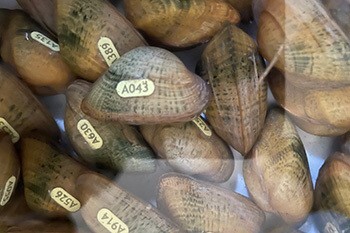
A thousand stocked snuffbox mussels were tagged with small physical tags with a unique identifier, glued to the outside of each mussel’s shell.
The DNR, USFWS, and USGS will be working together to monitor these populations and to collect data for future research.
A thousand mussels were tagged with passive integrated transponder, or PIT, tags and another thousand were tagged with small physical tags with a unique identifier, glued to the outside of each mussel’s shell.
The rest of the stocked snuffbox received a color marking on their shells. That will enable researchers to evaluate survival of the mussels, their reproductive success, movement, and whether they’re affected by invasive zebra or quagga mussels.
Photos:
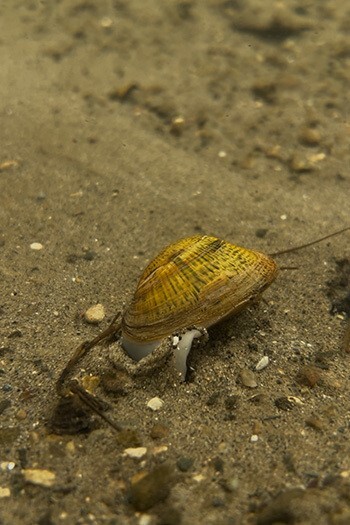
Snuffbox mussel: A snuffbox mussel stocked in southeast Michigan by the Department of Natural Resources, U.S. Fish and Wildlife Service and U.S. Geological Survey.
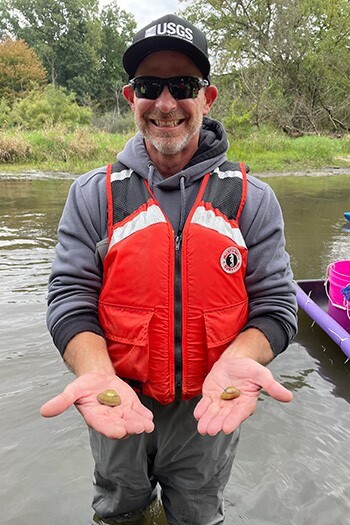
Stocking mussels: A U.S, Geological Survey staffer holds snuffbox mussels being stocked in southeast Michigan waters.
Tagged mussels: A thousand stocked snuffbox mussels were tagged with small physical tags with a unique identifier, glued to the outside of each mussel’s shell.
Harris will be a featured guest on WHMI's Viewpoint program, which airs Sunday mornings at 8:30. Those programs are later uploaded to the podcast section of our website, under the “programming” tab.