




Congressional Candidate Bridget Brink Says White House Disinvited Her From Trump-Zelenskyy Meeting Before Policy Shift Led Her To Resign As U.S. Ambassador to Ukraine
June 2, 2026
Matthew Hutchison / WHMI News
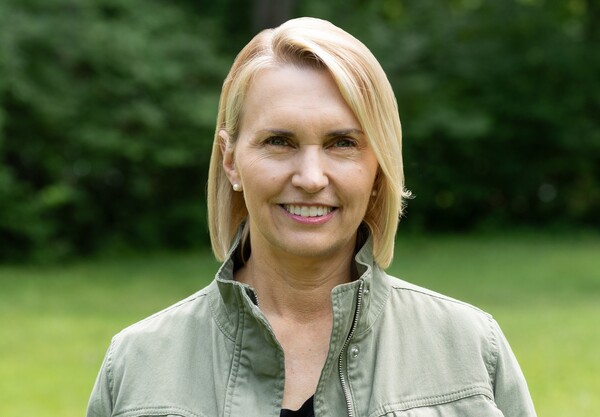
Former U.S. Ambassador to Ukraine Bridget Brink says she was called back to Washington to join the now-infamous Oval Office meeting between President Donald Trump and Ukrainian President Volodymyr Zelenskyy early last year, only to be disinvited by the White House and left to watch the exchange on TV from the State Department.
Brink, who is running as a Democrat in Michigan’s 7th Congressional District, said the moment caused her to reconsider whether she could continue serving as America’s top diplomat in Kyiv. Her revelatory comments came in a wide-ranging interview on WHMI’s “Meet the People,” where she offered new details about her resignation as ambassador and what she described as a shift in official U.S. language that stopped treating Russia as the clear aggressor in the war.
A resident of Lansing, Brink said she did not initially plan to resign when Trump returned to office in January 2025 and had told family members that she wanted to help shape policy.
“When President Trump was elected into office, I didn’t think I would resign – I had worked for five presidents, including President Trump in his first term,” Brink said. “And, then, within the first few weeks of the Trump administration, there was a meeting between President Trump and President Zelenskyy in the Oval Office, the now infamous meeting. I was called back to Washington to join that meeting.”
Asked whether she was in the room, she said she was not. “I got back to Washington, and the White House said, ‘You’re disinvited from the meeting’.”
Brink said she has no idea why she was disinvited and watched the meeting on a TV at the State Department. “I was horrified,” she said, noting that it was at that point she reconsidered her decision to stay. “It was a complete disaster.”
Brink said she later had conversations with the administration not about the Oval Office incident but about U.S. policy toward the war.
“I, too, want to see an end to the war in Ukraine, Russia’s war in Ukraine, and I made many policy proposals to do so, and they were all ignored,” Brink said. Asked whether those proposals were ignored by the Trump administration, she answered yes.
Brink said her proposals centered on increasing pressure on Russian President Vladimir Putin, not pressuring Ukraine.
“Basically put more pressure on Putin. Yeah, every kind of pressure, show Putin that we aren’t going to stop, and that we’re going to stick together with our democratic allies, and we’re not going to let you bully Ukraine or anyone else,” Brink said. “It’s playground politics. You want to stop a bully, you got to punch him really hard in the face. That’s my view.”
Asked whether that was happening, Brink said, “It was not happening. The reverse was happening. The pressure was easing."
Brink said the shift was not only in policy but also in language.
“Instead of calling out Russia for sending missiles and drones, which I was living under, which my whole team and staff were living under, we were not even able to call out Russia to use the term Russia,” Brink said. “The name of how we talk about the conflict was no longer Russia’s war in Ukraine, it was the Russia-Ukraine war.”
Brink said that framing suggested the two countries bore equal responsibility.
“It was small and equal in ways, as if both sides are equally at fault,” Brink said. “And this is not how you solve a major, major crisis war. The biggest war in Europe since World War Two, the biggest threat to peace and security to Europe since World War Two. And why does that matter to us? Because Europe is our number one trading partner in the world, over a trillion dollars of trade and millions of jobs in Europe and millions of jobs in America, and it's our, it's the home of our strongest and our most important military alliance. So a threat to Europe is deeply problematic for the United States.”
Asked when that framing came down and from whom, Brink said, “At the beginning, well, of course, from the Secretary of State and the White House.”
“I think the main problem is the Trump administration and Donald Trump himself was not recognizing that Putin is an aggressor and this isn’t a danger, not just to Ukraine, but to Europe, including our NATO allies, which also means it’s a danger to the United States,” Brink said.
“I think the Ukrainians were just plain confused as to what was going on,” Brink said. “I think probably still are. I can’t speak for them, but I think they don’t understand why the United States has withdrawn support for their defense of their freedom and territory, and our approach has been the wrong approach.”
Brink, who resigned in April 2025, said Ukraine still lacks the security guarantees needed to end the war.
“The way to solve this war is to focus on how to give Ukraine security, together with our allies and our partners,” Brink said. Asked whether Ukraine has that now, Brink said, “They do not have that.”
Brink also described the unusual conditions under which she ran the U.S. Embassy in Kyiv. She said she and nine other diplomats returned to Ukraine in May 2022, about three months after Russia’s full-scale invasion, and rebuilt the embassy presence to about 1,000 people, all civilians, without U.S. troops on the ground.
“For three years we lived and worked with a single mission of helping to keep Ukraine free,” Brink said, adding that she and her team worked “at the speed of war” and often could not wait for Washington to approve decisions.
“I had a saying to my staff,” Brink said. “Is it immoral, illegal, or unethical? And if the answers are no, no, no, you can go ahead and do it.”
Brink said that approach allowed her team to act quickly during Russian attacks, aid Ukraine’s defense, support the country’s economy and help keep the energy grid running during repeated missile and drone strikes.
In her WHMI interview, Brink said she believed diplomacy had helped the U.S. support Ukraine without putting American troops on the ground.
“This is why I’m very proud. What you can do with diplomacy, what you can do without actual boots on the ground, without risking our service members,” Brink said.
Brink is seeking the Democratic nomination to challenge Republican Congressman Tom Barrett in Michigan’s 7th Congressional District. The district includes all of Ingham, Livingston, Clinton and Shiawassee counties, most of Eaton County and parts of Oakland and Genesee counties.
The full interview with Ambassador Brink airs at 6 a.m. Sunday morning on WHMI and is available on demand at WHMI.com.