




Congressman Barrett Says Threat of Dishonorable Discharge Over COVID Vaccine Helped Send Him to Congress
May 14, 2026
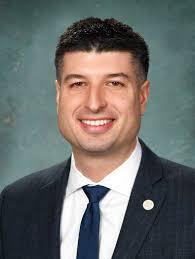
By Matthew Hutchison / WHMI News
U.S. Rep. Tom Barrett, who is running for re-election in Michigan’s 7th Congressional District, shared in a wide-ranging interview on WHMI’s “Meet the People” what he described as a threat of dishonorable discharge from the Biden Administration over his resistance to the COVID vaccine – an incident, he said, that helped compel him to run for Congress.
Barrett has shared concerns about the vaccine mandate for service members previously but the specific claim that he personally was threatened with a dishonorable discharge had not been shared in such detail previously.
“I was threatened with a dishonorable discharge after more than 20 years in the Army,” Barrett told WHMI in the interview airing in full this Sunday morning and available on demand now on WHMI.com. “I had COVID. I recovered from it. I donated my antibodies to try and help other people recover from it, and yet they wanted me to be forced to take a vaccine instead of just accepting the fact that I had already recovered from the virus itself. It was against the Army regulation, and they still said that they were going to threaten me with a dishonorable discharge if I didn’t comply.”
Barrett is running for re-election in one of the most closely watched U.S. House races of the 2026 midterms. While he faces no Republican primary opponent, three Democrats – Bridget Brink, a former U.S. ambassador to Ukraine; Matt Maasdam, a former Navy SEAL and military aide to President Obama; and William Lawrence, an activist and community organizer who previously appeared on “Meet the People” – are competing in the August primary for the chance to face him in November.
Barrett said the episode forced him to wrestle with leaving behind a two-decade military career that began immediately after high school and included service in Iraq, Kuwait, Guantanamo Bay and near the Korean DMZ.
“I made the decision to retire from the Army. It was really a decision I wrestled with — something that I had put my whole life into,” Barrett said. “If Joe Biden isn’t going to accept the service I’ve given this country, everything that’s been asked of me, I’m not going to beg him to keep me around. I’ll make the decision to leave, but I’m going to make the decision to leave and instigate that to run for Congress and try and right the ship and turn things around.”
“It’s been a big priority of mine to try and make sure that military members today aren’t suffering those same issues that we were in the last administration,” he said.
In the same interview, Barrett also discussed new legislation he introduced just last week: the Authorization for Use of Military Force related to Iran. That bill would give President Donald Trump congressional authorization for a defined 90-day mission, while barring sustained ground combat, nation-building, occupation or the seizure of Iranian territory.
While he said Iran cannot be allowed to obtain a nuclear weapon, Barrett argued the United States also cannot drift into another open-ended conflict in the Middle East.
“We can’t have 20-year-long endless wars in our country,” Barrett said, saying the measure reflects lessons he drew from post 9/11 wars and his own military service. “We can’t allow that to continue to happen. We can’t do nation building in countries that don’t share our values and don’t share our worldview and don’t see these intrinsic ideas of freedom, liberty and democracy and values the way that we do and we take for granted so much in America.”
While Barrett forcefully defended the core purpose of the Iran operation, saying the United States could not allow Tehran to obtain a nuclear weapon, he compared Iran’s trajectory to North Korea’s nuclear development and said Iran presents a different kind of threat.
“I think that we can have two things in mind at once. One is that Iran cannot have a nuclear weapon. We know what they would do if they obtained one,” Barrett said. “We can’t allow them to have a nuclear weapon because, unlike the North Koreans, the Iranians have a martyrdom interest in mind with these nuclear weapons.”
Barrett’s bill comes after the 60-day clock under the War Powers Act expired May 1.
Beyond Iran, Barrett detailed four pillars that are anchoring his re-election campaign: economic security, neighborhood security, national security and border security.
On the economy, Barrett, a father of four, said he understands the pressure families are under from stubbornly high inflation and gas prices, which are at four-year highs.
“I totally understand what people are going through when gas is, you know, $4.50, $4.75 a gallon,” he said. “I know what it’s like to be on an income where that is very, very pressing for your family budget.”
On neighborhood security, Barrett said public safety should mean residents can “go about your life, take your kids for a walk, go to the park, not be harassed.” He pointed to Lansing’s violent-crime challenges and said he secured congressional funding for a mentoring program in Lansing Public Schools aimed at stopping gangs from recruiting younger children.
“We want to break the cycle of that happening - they’ve seen great success in that program,” Barrett said. “It’s really important to invest in things like that that bring about greater neighborhood security so that we don’t have Lansing ranked as one of the most violent cities in America.”
On national security, Barrett said the world is more dangerous today than when he served in Iraq, citing drone technology, artificial intelligence, terror cells, fentanyl and declining trust in institutions. He said AI presents major opportunities in areas like medicine and productivity, but also risks including deepfakes, elder scams and adversarial use.
“AI presents great opportunity, but human nature will always take effect,” Barrett said. “We have to be very, very mindful.”
On border security, Barrett said his time in the Michigan National Guard exposed him to border-security concerns in the Great Lakes, including people trying to move drugs across frozen waterways. He said the southern border remains the more acute problem and argued that stronger border enforcement is contributing to declines in opioid and fentanyl deaths.
Barrett is not the first in his family to serve in Congress. His great-grandfather, former Congressman Louis Rabaut, served in the U.S. House of Representatives from 1935 to 1947, then again from 1949 until his death in 1961. Rabaut sponsored the legislation that added the words “under God” to the Pledge of Allegiance.
When Barrett took office, he persuaded his colleagues to let him occupy his great-grandfather’s office, 1232 Longworth House Office Building. Barrett said his family keeps a copy of Rabaut’s legislation and an early version of the revised pledge on the wall of his office.
"We have a copy of the bill that added 'under God' to the Pledge of Allegiance. And then we have one of the very first copies of the Pledge after that was printed after the law was changed where the words ‘under God’ are highlighted in there, showing the new text,” Barrett said. “We named my youngest son, Louis, who’s now five years old, after my great-grandfather. That was an important legacy for us.”
The full interview airs Sunday morning on WHMI and is available on demand at Wthe link below.